
5 Factors That Influence Direct Primary Care Pricing


Direct primary care is a membership model in which you pay a flat monthly, quarterly, or annual fee for a defined set of primary care services, rather than billing insurance. Called DPC or retainer primary care, it supports longer visits, direct access to your clinician, and simpler pricing by cutting billing overhead. The model focuses on relationship-based care and continuity rather than luxury tiers.
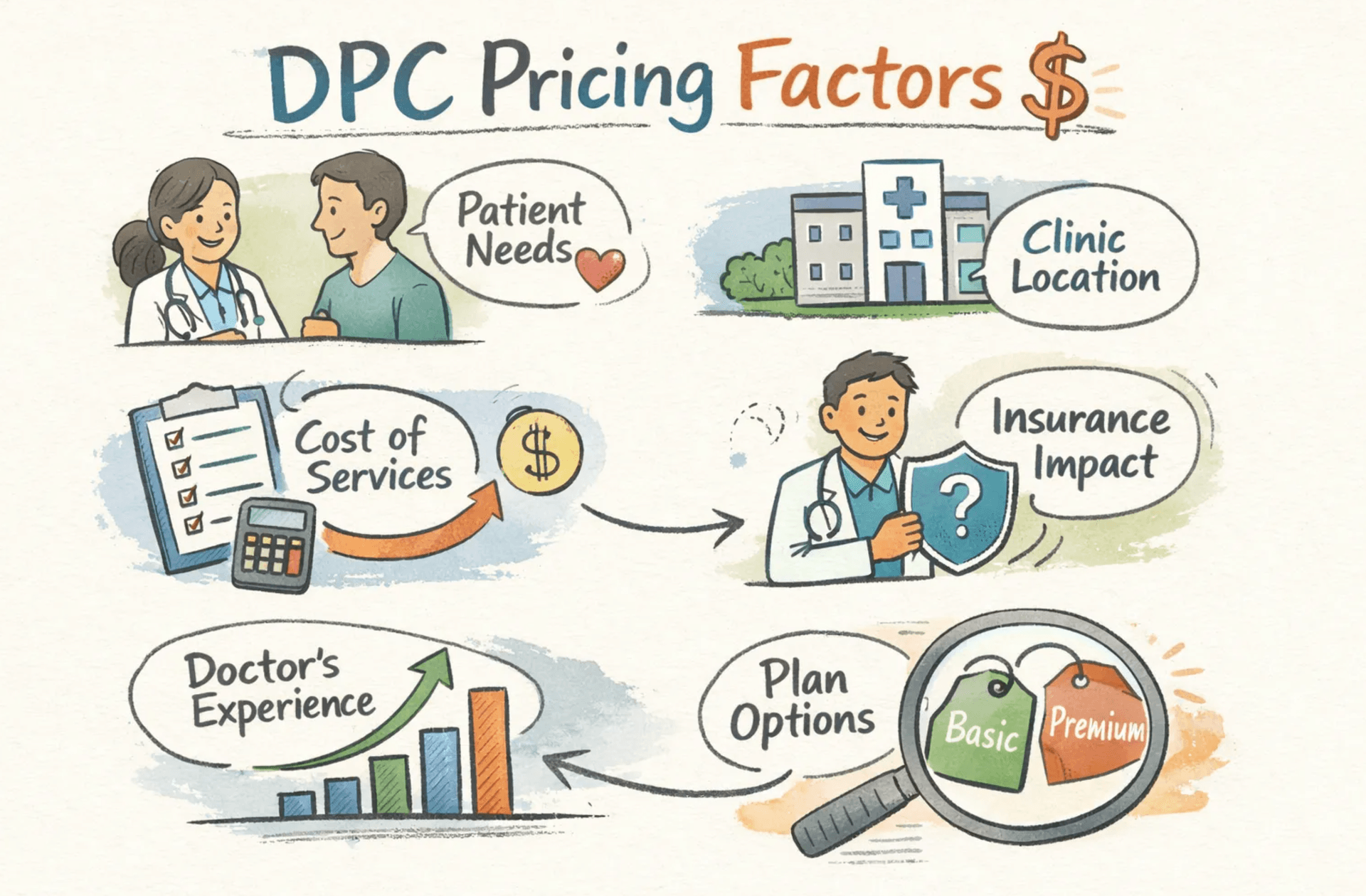
Key Takeaways
- Flat monthly or annual fees simplify billing and reduce surprise charges. Typical ranges are $65-$150 for adults, $50-$75 for children, and $150-$300 for families.
- Location affects price through rent, clinician wages, and local demand. Urban clinics usually sit at the higher end of national ranges, while lower-cost regions often offer more affordable memberships.
- Smaller patient panels deliver longer visits and better continuity but raise per-member fees. Larger panels lower the price but typically shorten visit time and access.
- Core memberships generally cover visits, chronic care, preventive services, and basic labs. Expect separate charges for advanced imaging, hospital care, specialist procedures, and some medications.
- Monthly billing offers flexibility; annual prepayment, family tiers, or employer plans often reduce per-member cost. Choose the payment terms and tier that match your budget and care needs.
How does direct primary care pricing work?
Prices vary by region and by what a practice includes. Typical ranges are $65 to $150 per month for adults, $50 to $75 for children, and $150 to $300 for family plans. Some practices charge a one-time enrollment fee, offer discounts for annual prepayment, or provide employer-sponsored group rates; guaranteed extras such as 24/7 clinician access, in-office procedures, or concierge-style bundles usually cost more.
Most memberships cover routine, high-frequency services that replace repeated co-pays and improve care coordination. Common inclusions are unlimited office or virtual visits, secure messaging, chronic disease management, preventive care, basic labs, and referral support. Advanced imaging, specialist procedures, hospital stays, and many brand-name prescriptions typically fall outside membership coverage.
Factor 1: Location and local market conditions
Location affects several cost categories: rent, clinician salaries and benefits, and the local cost of living. Urban clinics generally face higher overhead and set membership fees toward the top of national ranges. Rural practices can charge less but may offer fewer on-site services or longer referral pathways. In Tampa Bay, coastal rent, a competitive clinician market, and dense employer demand push operating costs up. Clinics serving diverse communities may hire bilingual staff and add specialty services, which raises expenses while improving access. South Beach Wellness Center structures an all-in membership to support extended visits, telehealth, and EvexiPEL-certified hormone therapy within the regional market; see Why Direct Primary Care is Affordable at South Beach Wellness Center Wesley Chapel for details. Community income, employer-sponsored options, and local competition also influence fees. Higher-income neighborhoods and employer plans can support premium packages, while strong demand for affordable care may lead to lower-priced entry tiers or sliding-scale options. Comparing services and local prices helps you judge value rather than focusing only on the sticker price.
Factor 2: Access level and patient panel size
Panel size is a central driver of membership pricing because fewer members mean more clinician time per patient and higher per-member fees. To illustrate: to generate $300,000 in annual revenue a singlephysician practice needs about $25,000 per month; that works out to roughly $63 per member with 400 members, $42 with 600 members, or $83 with 300 members. This math explains why many DPC practices cap panels between roughly 300 and 600 patients, unlike traditional primary care panels that often number in the thousands.
Access commitments also change costs when they require additional clinician hours or staffing backups. Features that raise membership prices include guaranteed same-day visits, defined response windows for secure messaging, house calls, and extended 30- to 60-minute visits. Around-the-clock coverage requires paid on-call time or triage staff, so memberships reflect those labor costs. For more background on the direct primary care model, see the Direct Primary Care on Wikipedia.
Tiered memberships let practices balance access and price so patients can choose what matters most. Typical tiers start with office visits and telehealth, add on-site labs or specialist coordination at higher levels, and offer family or employer bundles. Concierge medicine tends to combine more exclusive access with higher fees in a single premium tier.
Factor 3: Scope of services and add-ons
What a practice includes in its scope of services directly shapes membership pricing. Focused core offerings keep per-member overhead lower while delivering predictable value. Most core plans cover preventive visits, chronic disease care, routine labs, immunizations, and simple in-office procedures like skin checks or minor wound care. For an overview of common benefits and FAQs, see Direct Primary Care FAQ and Benefits.
High-value specialty services increase costs because they require extra clinician time, supplies, or training. Examples include medical weight loss programs, bioidentical hormone therapy such as EvexiPEL pellet insertion, testosterone replacement, and vitamin therapy. Practices often offer these services as discounted add-ons or bundled upgrades so members can tailor care without surprise bills.
Certain high-cost items typically remain outside membership coverage, including advanced imaging, surgical or specialist procedures, hospital admissions, and many brand-name prescriptions. Cash prices for these services vary: an MRI can cost several hundred to a few thousand dollars, a specialist consult often runs $150 to $400, and hospital stays vary widely.
Factor 4: Operational costs, staffing, and certifications
Fixed operational costs, such as payroll and clinic space, drive membership pricing. A clinic that staffs a full front desk team, licensed nurses, medical assistants, and bilingual patient navigators will have higher salary and benefit costs than a leaner operation that relies more on remote triage. Facility rent, utilities, and clinical supplies add to the budget as well.
Recurring technology subscriptions add another steady expense. Telehealth platform fees, electronic medical record hosting, and lab or billing interfaces scale with patient volume and security needs. Those tools shorten administrative work so clinicians can spend more time with patients.
Certifications and on-site equipment increase both overhead and what a clinic can safely offer. Point-of-care labs, infusion chairs, and certified training for BHRT or infusion procedures require capital investment, quality checks, and consumables. Community-focused investments such as longer hours, employer partnerships, and bilingual education raise costs but reduce barriers to care.
Factor 5: Pricing strategy, payment terms, and budgeting tips
Payment terms and pricing strategy affect affordability and predictability. Monthly billing gives flexibility, while annual prepayment usually reduces the per-member price; employer-sponsored plans often lower rates by spreading risk. Family plans commonly apply tiered discounts, typically 10 to 30 percent off for additional members.
Example scenarios illustrate how totals add up. Scenario A: a membership at $80 per month equals $960 per year; add a single acute out-of-pocket episode of $1,500 and your total would be about $2,460. Scenario B: a traditional plan with a $30 copay, four PCP visits, one set of labs, and an urgent care visit might cost roughly $600 out-of-pocket, plus higher premiums — for a comparison that highlights the differences, see 5 Reasons Direct Primary Care Outshines Traditional Primary Care.
Before joining, ask the practice what exactly is included and excluded, request sample cash prices for excluded items, and confirm panel size, same-day access policies, and cancellation or refund terms.
Those answers clarify when you will pay extra and help you compare plans on value rather than sticker price. Direct primary care memberships do not replace catastrophic or specialist insurance, so maintain appropriate coverage for hospitalization or specialty procedures. For additional reading on the model and outcomes, see this peer-reviewed review of direct primary care.
Why these pricing factors matter for your care
Knowing how direct primary care pricing is set helps you pick the membership that fits your health needs and budget. Focus on what the membership includes and how easily you can see your provider—those two things most affect your experience and costs.